The words on your notice,in plain English.
71 terms an Indian business owner actually meets — on the GST portal, in an income-tax intimation, on a bank's document list — each defined to the law in force today, with the page that helps you act on it.
every term, with the page that helps you act on it
The Consulting Crew
A strategy that drives resultsGST
GST terms
- ASMT-10ASMT-10 is the notice a GST officer issues after scrutinising your filed returns, listing specific discrepancies — such as mismatches between GSTR-1 and GSTR-3B, or between input tax credit claimed and GSTR-2B — and asking you to explain or pay.
- Composition schemeThe composition scheme is a simplified GST option where small businesses pay a flat, low rate of tax on turnover instead of regular GST, with no input tax credit and minimal filing.
- DRC-01DRC-01 is the summary of a show cause notice under GST — the formal demand document a tax officer issues when they believe you have unpaid or short-paid tax, wrongly claimed input tax credit, or received an erroneous refund.
- E-invoicingE-invoicing is the GST system where B2B invoices must be reported to a government Invoice Registration Portal (IRP), which returns a unique Invoice Reference Number (IRN) and signed QR code before the invoice is legally valid.
- E-way billAn e-way bill is the electronic document you must generate on the e-way bill portal before moving goods worth more than ₹50,000, whether by road, rail, or air.
- GST 2.0GST 2.0 is the September 2025 overhaul of India's GST rate structure that replaced the old four-slab system with three working rates — 0%, 5%, and 18% — plus a 40% rate for select luxury and sin goods.
- GSTINGoods and Services Tax Identification NumberA GSTIN (Goods and Services Tax Identification Number) is the 15-character registration number every GST-registered business in India holds, one per state.
- GSTR-1GSTR-1 is the GST return where you report every outward supply — your sales, invoice by invoice — monthly or quarterly under the QRMP scheme.
- GSTR-2BGSTR-2B is the static, auto-drafted statement of input tax credit available to you for a tax period, built from the invoices your suppliers filed in their GSTR-1.
- GSTR-3BGSTR-3B is the summary GST return where you declare total outward liability, claim input tax credit, and pay the net tax — monthly for most businesses, quarterly under QRMP.
- GSTR-9GSTR-9 is the annual GST return that consolidates everything you reported through GSTR-1 and GSTR-3B during a financial year, due by 31 December of the following year.
- HSN codeHarmonised System of NomenclatureAn HSN code (Harmonised System of Nomenclature) is the internationally standardised number that classifies goods under GST and determines which tax rate applies; services use the parallel SAC codes.
- Input tax creditITCInput tax credit (ITC) is the GST you paid on business purchases that you subtract from the GST you collect on sales, so you effectively pay tax only on your value addition.
- Invoice Management SystemIMSThe Invoice Management System (IMS) is the dashboard on the GST portal where you accept, reject, or keep pending each invoice your suppliers report, before it flows into your GSTR-2B and becomes claimable input tax credit.
- LUTLetter of UndertakingA Letter of Undertaking (LUT) is a declaration filed on the GST portal in form RFD-11 that lets you export goods or services, or supply to SEZ units, without paying IGST upfront.
- QRMP schemeQuarterly Return filing and Monthly PaymentThe QRMP scheme (Quarterly Return filing and Monthly Payment) lets businesses with annual turnover up to ₹5 crore file GSTR-1 and GSTR-3B once a quarter while paying tax monthly by challan.
- Reverse charge mechanismRCMReverse charge mechanism (RCM) is where the buyer, not the seller, pays GST directly to the government on notified supplies — common examples are goods transport agency services, legal services from advocates, and import of services.



Income tax
Income tax terms

- Advance taxAdvance tax is income tax paid in instalments during the year you earn the income, rather than in one lump sum at filing time.
- AISAnnual Information StatementThe AIS is the income tax department's detailed statement of your financial transactions for the year, compiled from banks, mutual funds, registrars, employers and other reporters.
- Belated returnA belated return is an income tax return filed after the original due date but within the extended window the law allows.
- Capital gainsCapital gains are profits from selling a capital asset — shares, mutual funds, property, gold — taxed separately from your regular income.
- Form 16Form 16 is the TDS certificate an employer must give every employee whose salary suffered tax deduction at source, summarising the year's salary paid and tax deducted and deposited.
- Form 26ASForm 26AS is your consolidated annual tax statement on the income tax portal, showing all tax deposited against your PAN — TDS deducted by others, TCS collected from you, advance tax and self-assessment tax you paid, and refunds issued.
- ITR formsIncome tax return formsITR forms are the prescribed formats (ITR-1 to ITR-7) for filing an income tax return in India, chosen based on who you are and what income you earn.
- New tax regimeThe new tax regime is India's default personal income tax structure — lower slab rates in exchange for giving up most deductions and exemptions like 80C, HRA and home loan interest.
- Presumptive taxationPresumptive taxation lets small businesses and professionals declare profit as a fixed percentage of turnover instead of maintaining detailed books and getting audited.
- Revised returnA revised return replaces an income tax return you already filed, correcting mistakes or omissions discovered later.
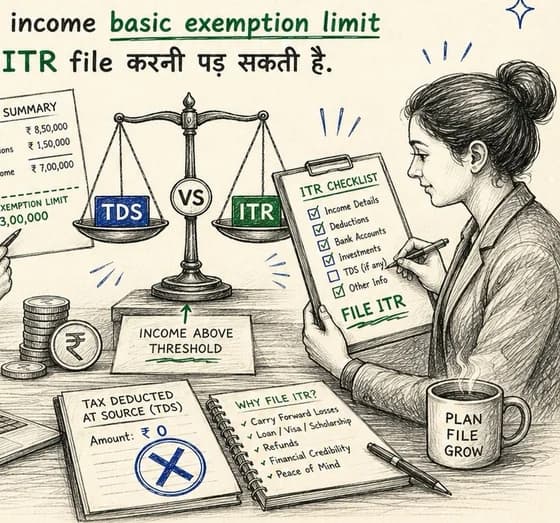
- Section 87A rebateThe section 87A rebate is a tax rebate for resident individuals that wipes out tax liability below an income threshold — under the new regime it makes normal income up to ₹12 lakh effectively tax-free.
- Tax auditA tax audit is a compulsory examination of your books by a chartered accountant under section 63 of the Income-tax Act 2025 (the old section 44AB), triggered when turnover crosses prescribed limits.
- Tax yearThe tax year is the 12-month period from 1 April to 31 March for which income is taxed under the Income-tax Act 2025, in force since 1 April 2026.
- TCSTax collected at sourceTCS is tax collected at source — the seller collects a small percentage of tax from the buyer on specified transactions, such as sale of scrap or high-value motor vehicles, and deposits it against the buyer's PAN.
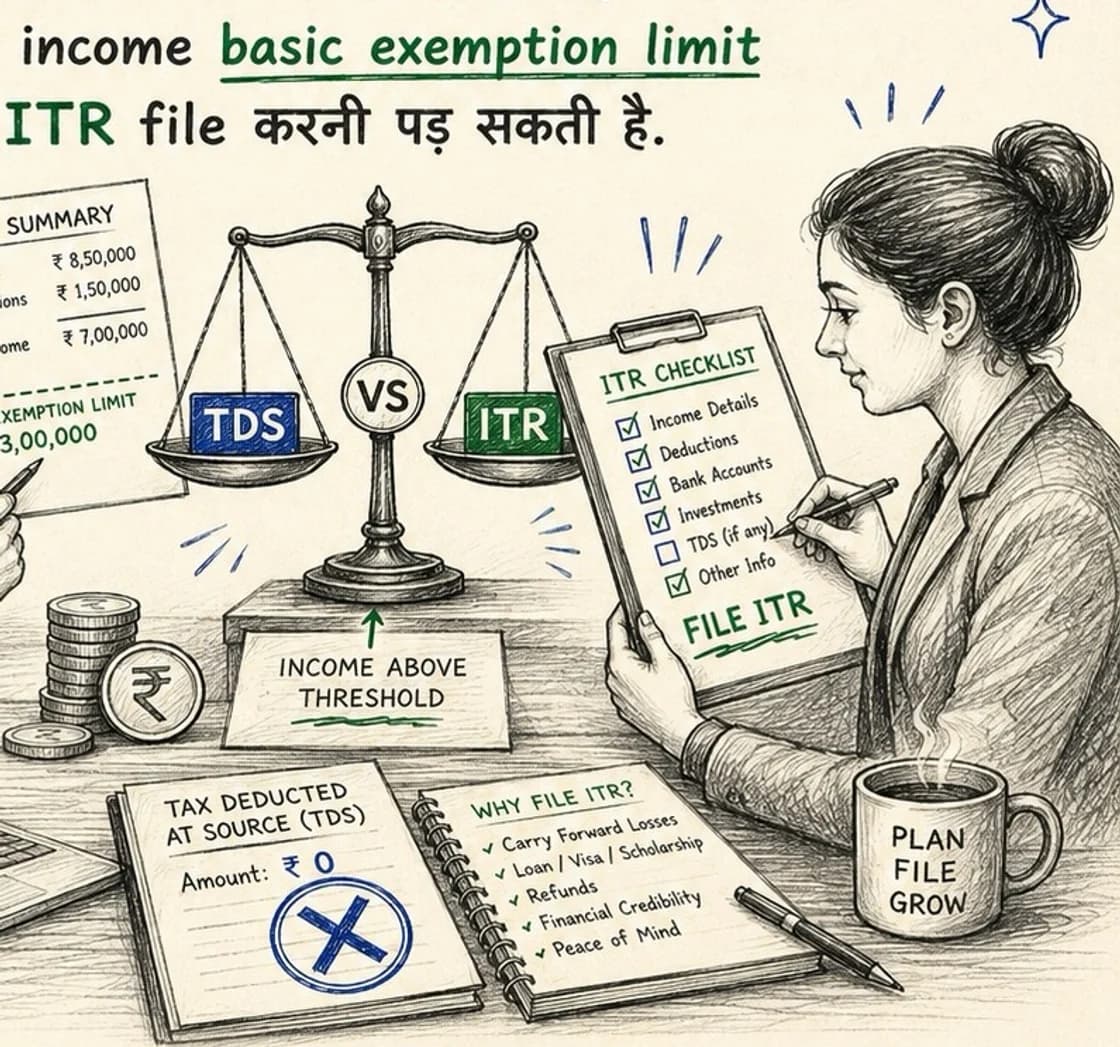
- TDSTax deducted at sourceTDS is tax deducted at source — the payer cuts a percentage from specified payments like rent, interest, contractor fees or professional fees and deposits it with the government against the payee's PAN.
- Updated return (ITR-U)Updated income tax returnAn updated return, filed on form ITR-U, lets you declare missed or under-reported income even after the belated and revised return deadlines have passed.







Company & ROC
Company & ROC terms

- AGMAnnual General MeetingAn AGM (annual general meeting) is the yearly shareholders' meeting every company (except a one person company) must hold under section 96 of the Companies Act 2013.
- AOC-4AOC-4 is the e-form every Indian company files with the Registrar of Companies to submit its audited financial statements — balance sheet, profit and loss, auditor's report and board's report.
- CINCorporate Identification NumberA CIN (Corporate Identification Number) is the unique 21-character alphanumeric code the Registrar of Companies assigns to every company incorporated in India.
- DINDirector Identification NumberA DIN (Director Identification Number) is a unique 8-digit number the Ministry of Corporate Affairs allots to any individual who is or intends to become a director of an Indian company.
- DIR-3 KYCDIR-3 KYC is the annual identity verification every DIN holder must complete with the Ministry of Corporate Affairs by 30 September each year.
- DSC (digital signature certificate)Digital Signature CertificateA DSC (digital signature certificate) is the electronic equivalent of a physical signature, issued by a licensed certifying authority and stored on a USB token.
- IncorporationIncorporation is the legal process of registering a company with the Registrar of Companies, creating an entity separate from its owners with limited liability.
- LLPLimited Liability PartnershipAn LLP (limited liability partnership) is a hybrid business structure under the LLP Act 2008 that combines a partnership's flexibility with limited liability for its partners.
- MGT-7MGT-7 is the annual return every Indian company files with the Registrar of Companies, capturing its shareholding, directors, meetings and other governance details as at the financial year end.
- MOA & AOAMemorandum of Association & Articles of AssociationThe MOA (Memorandum of Association) and AOA (Articles of Association) are a company's two charter documents, filed at incorporation.
- OPC (one person company)One Person CompanyAn OPC (one person company) is a private limited company with a single shareholder, allowed under section 2(62) of the Companies Act 2013.
- ROCRegistrar of CompaniesThe ROC (Registrar of Companies) is the Ministry of Corporate Affairs office that registers companies and LLPs and polices their compliance under the Companies Act 2013 and LLP Act 2008.
- Share capitalShare capital is the money a company raises by issuing shares to its owners.
- Statutory registersStatutory registers are the records the Companies Act 2013 requires every company to maintain, usually at its registered office — chiefly the register of members, register of directors and key managerial personnel, register of charges, and registers of share transfers, loans, investments and related-party contracts.




Payroll & labour
Payroll & labour terms

- ESIEmployees' State InsuranceESI (Employees' State Insurance) is the statutory health-insurance and social-security scheme for establishments with 10 or more employees, covering staff earning up to ₹21,000 a month (₹25,000 for persons with disability).
- GratuityGratuity is a statutory lump sum payable when an employee leaves after five years of continuous service — roughly 15 days' wages per completed year, computed as last drawn basic plus DA × 15/26 × years of service.
- Professional taxProfessional tax is a state-level tax on salaried employment, professions and trades, constitutionally capped at ₹2,500 per person per year.
- Provident fund (PF)EPF: Employees' Provident FundProvident fund (EPF) is the mandatory retirement-savings scheme run by the EPFO for establishments with 20 or more employees.

MSME & finance
MSME & finance terms
- PMEGPPrime Minister's Employment Generation ProgrammePMEGP is the central government's margin-money subsidy scheme for new micro enterprises: a bank funds the project and the government pays 15–35% of the cost as a subsidy that is adjusted against the loan after three years.
- Mudra loanPradhan Mantri Mudra YojanaA Mudra loan is a collateral-free loan of up to ₹20 lakh to a non-farm micro enterprise, made by a bank, NBFC or microfinance institution and guaranteed under the Credit Guarantee Fund for Micro Units.
- ME-CardMicro Enterprise Credit CardThe ME-Card is a revolving credit card with a limit of up to ₹5 lakh for Udyam-registered micro enterprises, launched on 25 May 2026 with a 75% government guarantee to the issuing bank.
- RIPS 2024Rajasthan Investment Promotion Scheme 2024RIPS 2024 is Rajasthan's incentive scheme for new and expanding units, valid to 31 March 2029: a capital subsidy of up to 28% (capped at ₹15 crore), reimbursement of up to 75% of SGST for ten years, an interest subsidy of 0.5–2%, stamp-duty exemption of up to 75% and full electricity-duty exemption for renewable energy.
- MLUPYMukhyamantri Laghu Udyog Protsahan YojanaMLUPY is Rajasthan's interest-subsidy scheme for small units: on a bank loan for a manufacturing or service project of up to ₹10 crore (₹1 crore for trading), the state pays 8% of the interest on loans up to ₹25 lakh, 6% up to ₹5 crore and 5% up to ₹10 crore, for five years.
- Credit score (CIBIL score)A credit score is a three-digit number between 300 and 900 that a credit bureau — TransUnion CIBIL, Experian, Equifax or CRIF High Mark — computes from your loan and card history to predict how likely you are to repay.
- Credit report (CIR)Credit Information ReportA credit report, or credit information report (CIR), is the bureau's account-by-account record of every loan and card in your name — sanctioned amount, balance, status, and the month-by-month repayment record — from which your credit score is computed.
- DPDDays Past DueDPD, or days past due, is the number of days a loan or card payment was late in a given month, as reported by the lender to the credit bureau.
- Credit utilisation ratioCredit utilisation is the share of your total sanctioned credit-card limits that is in use on the statement date — ₹60,000 outstanding on limits totalling ₹2 lakh is 30%.
- CMRCIBIL MSME RankCMR, the CIBIL MSME Rank, is the commercial equivalent of a credit score for a business that has loans in its own name — a rank from 1 (lowest risk) to 10 (highest), computed by TransUnion CIBIL from the company's repayment record, utilisation of its limits and recent enquiries.
- Bank reconciliationBank reconciliation is the process of matching the bank ledger in your books against the actual bank statement and explaining every difference — cheques issued but not cleared, receipts credited by the bank but not yet recorded, charges and interest the bank applied that the books missed.
- CGTMSECredit Guarantee Fund Trust for Micro and Small EnterprisesCGTMSE (Credit Guarantee Fund Trust for Micro and Small Enterprises) is a government trust that guarantees collateral-free loans to micro and small enterprises.
- CMA reportCredit Monitoring ArrangementA CMA (Credit Monitoring Arrangement) report is the standardised set of financial statements and projections banks require before sanctioning or renewing business loans and working-capital limits.
- MIS reportManagement Information SystemAn MIS (management information system) report is the periodic — usually monthly — pack of financial and operational reports a business runs on: profit and loss, cash flow, debtor and creditor ageing, key ratios and comparisons against budget or last year.
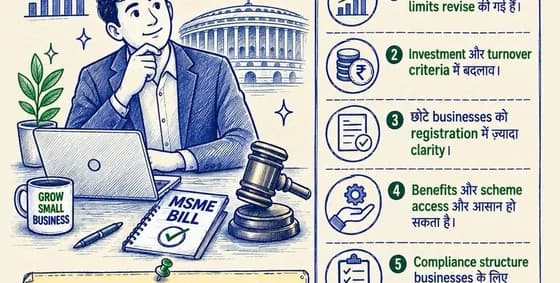
- MSME classificationMSME: micro, small and medium enterprisesMSME classification is the official sizing of a business as micro, small or medium using two tests read together: investment in plant, machinery or equipment, and annual turnover.
- Section 43B(h) 45-day ruleThe 45-day MSME payment rule — section 43B(h) of the 1961 Income-tax Act, carried into the Income-tax Act 2025 — denies a buyer the tax deduction for purchases from micro and small enterprises that remain unpaid beyond the MSMED Act limit: 15 days, or a maximum of 45 days where a written agreement exists.
- TReDSTrade Receivables Discounting SystemTReDS (Trade Receivables Discounting System) is a set of RBI-regulated online platforms where MSMEs auction their unpaid invoices on large buyers to banks and financiers, converting receivables into cash within days instead of waiting out long credit periods.
- Udyam registrationUdyam registration is the government's free, paperless self-registration for micro, small and medium enterprises, done on the Udyam portal with the owner's Aadhaar and PAN.
- Virtual CFOA virtual CFO is an outsourced finance professional or firm that does a chief financial officer's work — monthly MIS, cash-flow planning, budgeting, banking and compliance oversight, pricing and margin decisions — on a part-time, retainer basis.
- Working capitalWorking capital is the money a business keeps tied up in day-to-day operations — broadly current assets (stock, debtors, cash) minus current liabilities (creditors, short-term dues).


Reading a term because a notice used it?
Send us the notice on WhatsApp — a named expert replies with what it means for you and what to do next. Free, no obligation.
- Reply within one working hour on WhatsApp
- Fixed monthly fee, agreed before any work starts
- No lock-in — month to month, 15 days’ notice
Request a callback
Two fields and you are done. We reply on WhatsApp within one working hour, Mon–Fri 10:00–19:00 and Sat 10:00–14:00 IST.
or message us on WhatsApp instead →