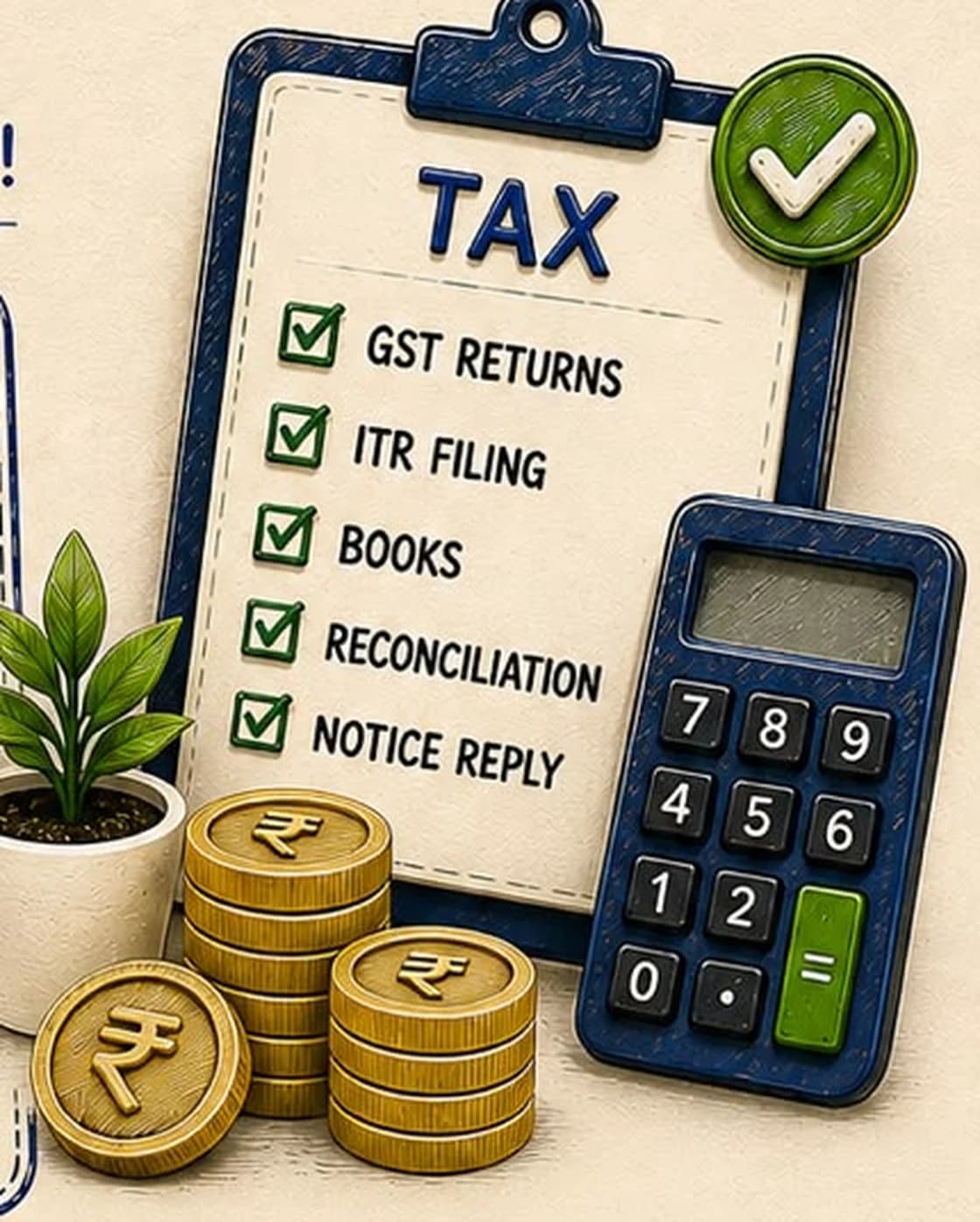
GSTR-9 & GSTR-9C Annual Returnfrom ₹7,999/-*
Accurate GST annual return and reconciliation, filed on time
+ 18% GST · no lock-in · Usually completed within 5–10 working days after data is received.

GST Annual Return,end to end.

At a glance
Starts at ₹7,999/-* · Usually completed within 5–10 working days after data is received.
- Reconciliation of GSTR-1, 3B and books
- ITC matching with 2A / 2B
- Preparation of GSTR-9 annual return
- GSTR-9C reconciliation statement where applicable
- Review of turnover, tax and ITC disclosures
- Filing on the GST portal
Reviewed by Ashish Kumar Sharma · Founder
Built forthese businesses.
Businesses with turnover above the GSTR-9 threshold
Taxpayers needing GSTR-9C reconciliation
Companies wanting clean year-end GST closure
Businesses with complex ITC and multiple GSTINs

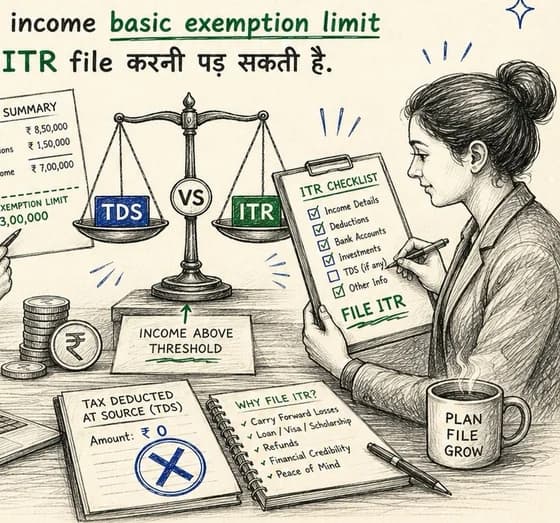


The GST annual return (GSTR-9) and reconciliation statement (GSTR-9C) are your year-end compliance closure under GST. We reconcile your monthly returns with your books and input tax credit records, then prepare and file accurate annual disclosures so you avoid notices and penalties.
What GSTR-9 and GSTR-9C are
GSTR-9 is the annual return under GST — a once-a-year consolidation of everything you reported month by month in GSTR-1 and GSTR-3B, laid against your books of account. GSTR-9C is the reconciliation statement that accompanies it for larger taxpayers: it maps the turnover, tax and input tax credit in the annual return to the audited financial statements and records a reason for every difference.
Since FY 2020-21, GSTR-9C is self-certified by the taxpayer rather than certified by an auditor. That sounds like a relaxation, but it shifts the entire responsibility for the reconciliation onto you — a casually prepared 9C is your own representation to the department.
Who must file, by turnover
Applicability turns on aggregate turnover — the PAN-level total across all your GSTINs, not each registration separately. GSTR-9 is optional (exempted by notification) up to ₹2 crore and mandatory above it; GSTR-9C applies once aggregate turnover crosses ₹5 crore. Both are due by 31 December following the end of the financial year, and the annual return is filed separately for each GSTIN even though the threshold is tested at PAN level.
What goes into each part
GSTR-9 runs to six parts, and most of the real work sits in two of them.
- Part II — outward supplies for the year: taxable, exempt, nil-rated and non-GST, built from GSTR-1 and GSTR-3B.
- Part III — input tax credit: ITC availed, reversed and ineligible, including the comparison of your claims against GSTR-2A/2B data.
- Part IV — tax actually paid during the year, in cash and through credit.
- Part V — previous-year transactions reported or amended in the current year's returns up to the cut-off date.
- Part VI — demands, refunds, HSN-wise summaries and late fees.
- GSTR-9C then reconciles audited-financials turnover with GSTR-9, tax payable rate by rate, and ITC per books with ITC claimed — with a stated reason for each gap.
The mismatches that surface at year-end
Almost every annual return we prepare turns up differences that monthly filing hid. The usual suspects:
- ITC claimed in GSTR-3B that does not tie to GSTR-2B or to the purchase register — timing differences, supplier defaults or duplicate claims.
- Outward supplies per GSTR-1 not matching GSTR-3B or the books — amendments, credit notes and advances landing in different periods.
- Reverse-charge liability sitting in the books but never paid through GSTR-3B.
- ITC reversals for exempt supplies or personal use not carried out during the year.
- Each difference must either be explained in the return or the shortfall paid voluntarily through DRC-03 — before the department finds it and adds interest and penalty.
Late fees and the three-year bar
The late fee for GSTR-9 accrues for every day of delay, at daily rates that scale with your turnover slab and are capped at a small percentage of turnover — with CGST and SGST components applying separately. On a multi-crore turnover the cap is far from trivial.
The harder deadline is the three-year bar: GST returns, the annual return included, can no longer be filed once three years have passed from their due date, and the portal enforces this. A skipped GSTR-9 does not just grow more expensive — it eventually becomes impossible to file, leaving a permanent hole in your compliance record.
Why prepare it with TCC
We treat the annual return as a reconciliation exercise, not a data-entry task: GSTR-1 vs 3B vs books, 3B vs 2B vs purchase register, tax paid vs tax payable — all resolved before anything is filed, with any genuine shortfall paid through DRC-03 on your instruction. Fixed fee, a working file you can produce in any future scrutiny, and confirmation on WhatsApp once filed.
What's included
- Reconciliation of GSTR-1, 3B and books
- ITC matching with 2A / 2B
- Preparation of GSTR-9 annual return
- GSTR-9C reconciliation statement where applicable
- Review of turnover, tax and ITC disclosures
- Filing on the GST portal
How we work
01
Data collection
We gather your returns, books and ITC registers.
02
Reconciliation
We reconcile GSTR-1, 3B, 2A/2B and books.
03
Preparation
We draft GSTR-9 and 9C with all disclosures.
04
Filing
We file after your review and confirmation.
Documents we need
- GSTR-1 and GSTR-3B for the year
- Purchase and sales registers
- GSTR-2A / 2B data
- Financial statements
- ITC ledger and reversals
Key rates & due dates
GSTR-9 and GSTR-9C applicability by aggregate turnover
| Aggregate turnover (PAN-level) | GSTR-9 annual return | GSTR-9C reconciliation |
|---|---|---|
| Up to ₹2 crore | Optional | Not required |
| ₹2 crore – ₹5 crore | Mandatory | Not required |
| Above ₹5 crore | Mandatory | Mandatory (self-certified) |
Frequently asked
Who must file GSTR-9?+
Every regular taxpayer whose aggregate PAN-level turnover for the year exceeds ₹2 crore. Below that, filing is optional — though often worth doing to lock the year's position cleanly.
Is GSTR-9C mandatory for me?+
Only if your aggregate turnover exceeds ₹5 crore. It has been self-certified since FY 2020-21 — no separate audit certification — but the reconciliation still has to be done properly, because it is your own representation to the department.
What is the due date?+
31 December following the end of the financial year, for both GSTR-9 and GSTR-9C. Extensions are occasionally notified, but plan around the statutory date.
Can GSTR-9 be revised after filing?+
No. There is no revision facility for the annual return, which is why every reconciliation difference must be settled before submission, not after.
What if reconciliation shows tax was short-paid?+
The shortfall can be paid voluntarily through DRC-03 with interest. Disclosing and paying before filing is far cheaper than the same amount surfacing later in a scrutiny notice with penalty added.
What is the late fee for delayed filing?+
It accrues daily at rates fixed by turnover slab and is capped at a percentage of turnover, with CGST and SGST components applying separately. We compute the exact figure for your slab before filing any delayed return.
Can you fix past mismatches?+
We reconcile and disclose differences correctly in the annual return, pay genuine shortfalls through DRC-03, and flag material errors with a corrective plan for the current year's filings.
Can I still file GSTR-9 for old years?+
Only within three years of the due date. Beyond that the law bars filing and the portal will not accept the return, so pending annual returns should be cleared without delay.
GST Annual Return across India. We file for clients in Jaipur, Jodhpur, Udaipur, Kota, Ajmer, Bikaner, Delhi, Mumbai, Bengaluru, Pune, Surat and Ahmedabad, and everywhere the portals reach.
Related services
- GST Return FilingMonthly GSTR-1 & GSTR-3B, reconciliation and on-time compliance
- GST RegistrationNew GSTIN for your business — end to end, error free
- Company ROCAnnual MCA filings — AOC-4, MGT-7, DIR-3 KYC and statutory registers
- GST Amendment & CancellationChanging, closing or reviving a GST registration — REG-14, REG-16 and REG-21
- GST AuditGSTR-9 & 9C reconciliation, ITC review and turnover matching
- ITR-1 FilingFor salaried individuals and pensioners with income up to the prescribed limit




Read more on the blog
Ready for hassle-free GST Annual Return?
Pick a slot or WhatsApp us — we'll take it from there.
- Reply within one working hour on WhatsApp
- Fixed monthly fee, agreed before any work starts
- No lock-in — month to month, 15 days’ notice
Request a callback
Two fields and you are done. We reply on WhatsApp within one working hour, Mon–Fri 10:00–19:00 and Sat 10:00–14:00 IST.
or message us on WhatsApp instead →