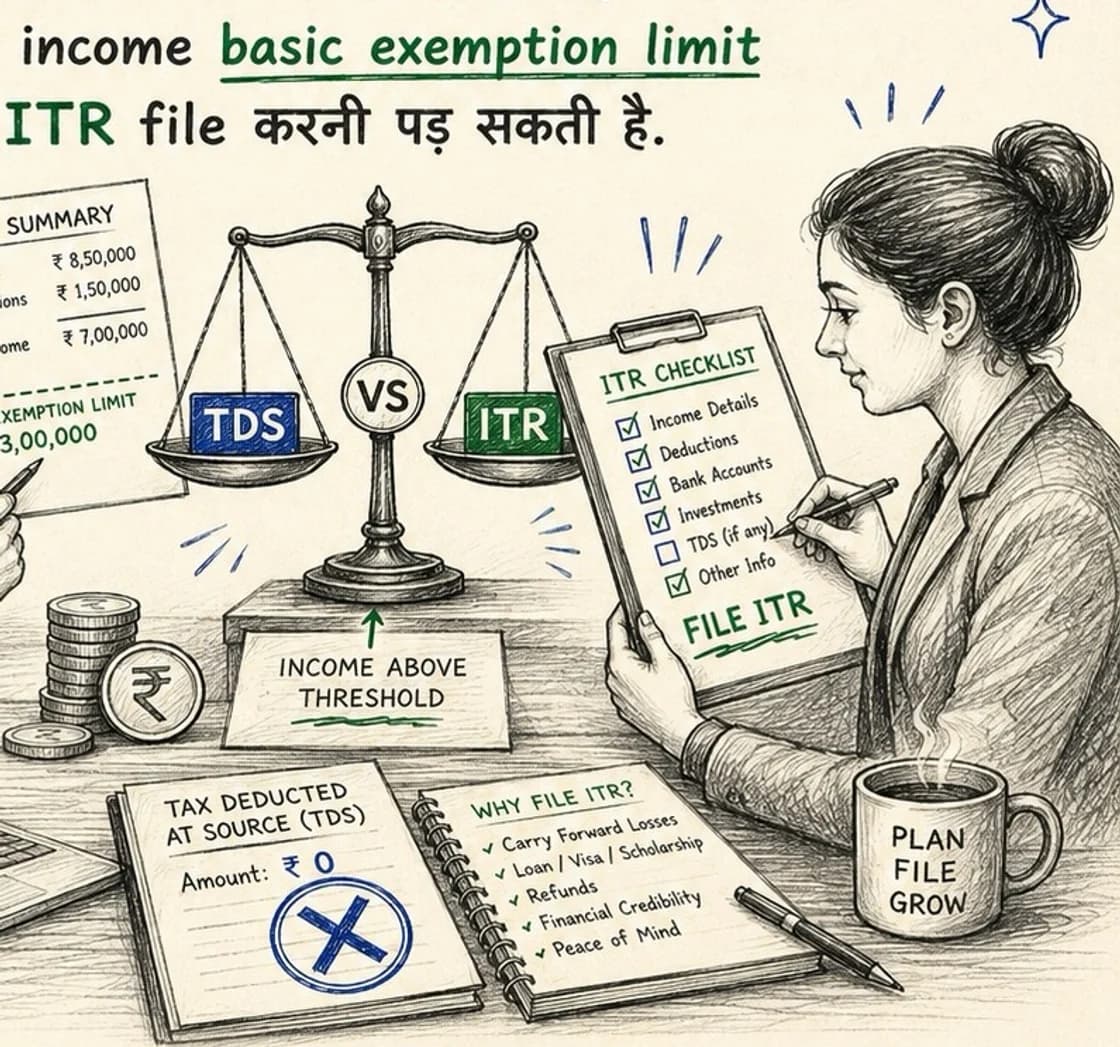

Every business owner has to file an income tax return, but the right form and process depend on how your business is structured and how you account for income. Getting it right keeps you penalty-free, protects your refunds, and keeps your records clean for loans and tenders. This guide covers which ITR form fits you, the difference between presumptive and regular taxation, the documents to keep ready, the deadlines, and the mistakes that trigger notices.
Which ITR form fits you
The correct form depends on your business structure and whether you opt for presumptive taxation. Filing the wrong form leads to a defective-return notice under section 139(9), so this is the first decision to get right.
Confirm your ITR form and audit trigger in two minutes →
| Form | Who files it |
|---|---|
| ITR-3 | Individuals/HUFs with business or professional income (including F&O and intraday) under normal taxation with books. |
| ITR-4 (Sugam) | Small businesses and professionals opting for presumptive tax under 44AD / 44ADA / 44AE. |
| ITR-5 | Partnership firms and LLPs. |
| ITR-6 | Companies (other than those claiming exemption under section 11). |
Presumptive vs regular taxation
The biggest choice for a small business is between presumptive taxation and regular (actual-profit) taxation. Under the presumptive scheme you declare a fixed percentage of turnover as income and skip detailed books:
- Section 44AD: eligible businesses declare 8% of turnover as income (6% for digital/bank receipts), with turnover up to ₹2 crore (₹3 crore where cash receipts are within 5%).
- Section 44ADA: eligible professionals declare 50% of gross receipts, with receipts up to ₹50 lakh (₹75 lakh where cash receipts are within 5%).
- Section 44AE: transporters with up to 10 vehicles declare a fixed amount per vehicle per month.
Presumptive filing uses ITR-4; full-books taxation uses ITR-3. If your real profit margin is below the presumptive rate, regular taxation with proper books may save tax — but it brings audit obligations once you cross the thresholds.
A quick example
A consultant with ₹30 lakh of professional receipts, all received digitally, can file under 44ADA declaring ₹15 lakh (50%) as income — no books, no audit. If their actual expenses were high and real profit was only ₹8 lakh, they could instead maintain books, file ITR-3 and declare the lower real profit, but would then face a tax audit because declared profit is below the presumptive rate while income exceeds the basic exemption. The right choice depends on the numbers; we model both.
Documents to keep ready
Keep your books or a summary of income and expenses, bank statements, GST returns, TDS certificates (Form 16A), details of advance tax paid, and any investment proofs for deductions. Reconciling these against your Annual Information Statement (AIS) and Form 26AS before you start makes filing smooth and prevents the mismatches that cause most notices.
The key deadlines
| Situation | Due date |
|---|---|
| Non-audit cases | 31 July of the assessment year |
| Tax-audit report | 30 September |
| Return where audit applies | 31 October |
| Belated / revised return | Usually up to 31 December |
Missing the deadline brings a late fee under section 234F (up to ₹5,000), interest under section 234A, and can take away the benefit of carrying forward certain business losses.
When a tax audit kicks in
A tax audit under section 44AB (now section 63 of the Income-tax Act 2025) becomes mandatory when business turnover exceeds ₹1 crore (₹10 crore where cash receipts and payments are each within 5%), or professional receipts exceed ₹50 lakh. It also applies if you declare profit below the presumptive rate with income above the basic exemption. See our tax audit service for how that works.
Common mistakes to avoid
- Picking the wrong form for your structure or scheme.
- Forgetting to report interest, dividend or other income that already shows in the AIS.
- Mismatches with Form 26AS and the AIS — the top cause of notices.
- Skipping e-verification within 30 days, which makes the return invalid.
- Opting out of 44AD casually — it locks you out of the scheme for five years.
The step-by-step filing process
- Reconcile your income and TDS against Form 26AS and the AIS, and finalise your books or turnover summary.
- Choose the correct form and decide between presumptive and regular taxation.
- Compute income, apply eligible deductions, and compare the old and new tax regimes.
- Pay any balance self-assessment tax before filing to avoid further interest.
- File the return on the income tax portal and e-verify within 30 days — the return is invalid until verified.
Advance tax: do not wait until July
If your total tax liability for the year exceeds ₹10,000, you are required to pay advance tax in instalments during the year — 15% by 15 June, 45% by 15 September, 75% by 15 December and 100% by 15 March. Businesses opting for the presumptive scheme get a concession: they can pay their entire advance tax in one instalment by 15 March. Missing advance tax triggers interest under sections 234B and 234C, so plan your cash flow around these dates rather than facing a lump sum and interest at filing time.
Maintaining books under section 44AA
If you do not use the presumptive scheme, section 44AA requires you to maintain proper books of account once your income or turnover crosses the specified limits. Inadequate records can attract a penalty under section 271A. Even where books are not strictly mandatory, keeping a clean record of sales, purchases, expenses and bank transactions makes filing accurate, supports your deductions if questioned, and is essential for the next point — raising finance.
Why timely ITR filing helps your business grow
Your filed returns are the financial passport of your business. Banks and NBFCs ask for two to three years of ITRs when assessing a loan or working-capital limit; government tenders often require them; and visa applications frequently do too. Consistent, on-time filing builds a credit history, while gaps or last-minute belated returns raise questions and can stall a loan. Filing well is not just compliance — it is groundwork for funding and expansion.
After you file: what to keep and watch for
Filing is not quite the end. Keep the acknowledgement (ITR-V), your computation, and the supporting documents for at least the period during which the return can be reopened — the department can issue notices for earlier years in certain cases. Watch your registered email and the income-tax portal for any intimation under section 143(1), which compares your return with the department's computation and may show a refund, a demand, or an adjustment. If a refund is delayed, confirm your bank account is pre-validated and your PAN is linked to Aadhaar, as both are common reasons refunds get stuck.
Got an intimation under 143(1)? What it means and how to reply →
Should you file yourself or use an expert?
For a salaried person with a single Form 16, self-filing is reasonable. But once business income, presumptive choices, GST reconciliation, depreciation or audit applicability enter the picture, the cost of a mistake — a wrong form, a missed disclosure, a mismatch notice — usually exceeds the cost of professional help. An expert also spots legitimate savings you might miss and stands behind the return if the department raises a query. For most small businesses, expert filing is cheap insurance against expensive errors.
For the regime decision that sits alongside form selection, read our guide on the new vs old tax regime, and for the presumptive scheme in depth see presumptive taxation under 44AD & 44ADA.
This article is general information, not tax or legal advice. Rules can change; confirm specifics for your business before acting.